

Every year, 600 million people fall ill after consuming contaminated food. 420,000 die from it. And yet, food safety remains a blind spot in public debate. Project P108, funded by the European Union, works to strengthen food chain safety systems in ten countries of the African Atlantic Façade. Its Project Leader unpacks the issues - in simple terms.
Food safety: what does it actually mean?
The idea is in fact very simple because it touches our daily lives directly: no one wants to fall ill from what they eat. That's precisely where food safety comes in: making sure what we consume doesn't pose a danger to our health. This requirement may seem obvious, almost automatic, precisely because it has become invisible in our habits. And yet, it underpins everything else. To be convinced of this, one example is enough: if you ask someone how they choose a restaurant, they’ll first say “because the food is good”. Rarely will anyone say “because I’m sure I won’t get sick there”. And yet, that that health guarantee is the prerequisite for all the others. Before taste, before pleasure, we need to be able to eat with confidence.
Which misconceptions need to be dismantled?
The most widespread one: thinking you’re safe. People forget to wash their hands, leave food out at room temperature, eat expired products. These high-risk behaviours are often tied to a vague conviction: "it only happens to other people".
Another misconception: that homemade or “natural” food is necessarily safer than industrial food. In Europe, almost all cases of
botulism (a deadly disease directly linked to food) come from home-made preserves or charcuterie, not from industrial products, which are subject to strict controls. Likewise, organic farming guarantees the absence of pesticides, but not of microbes. An organic salad can contain just as many bacteria as a product from conventional agriculture. In other words, food safety depends above all on the conditions of preparation, storage and control.
Finally: the idea that this is a problem confined to certain countries. No country in the world has eradicated foodborne diseases. The mad cow crisis, contaminated infant formula, and the recent scandals around cadmium in France all illustrate this. What matters is the capacity to prevent and manage them.
Why has food safety become a major CBRN issue?
Because today, food-related threats reach far beyond natural or accidental risks alone. P108 therefore covers the field of food defence: a pressing concern for the agri-food sector and public authorities as threats grow and diversify. This means putting in place safeguards for food production chains against possible intentional, malicious contamination by microbial, toxic or radiological agents. Such acts stem from a deliberate intent to harm populations, agri-food businesses or States. The awareness-raising and training of professionals in food production and control delivered under P108 will then enable work with stakeholders to integrate this type of threat into crisis response and management plans.
What is the situation in the African Atlantic Façade countries?
The ten countries share a broadly similar epidemiological landscape, but very uneven levels of development - and therefore very uneven resources devoted to food safety. The political will is there: every official we’ve met through Project 108 grasps the importance of the subject, and many already have ambitious action plans in place. However, resources don’t always match the political will.
The most worrying threats aren’t necessarily the most visible.
Among the most insidious threats: chemical contaminants. Unlike gastroenteritis, which is visible and immediate, chronic exposure to low doses of toxic substances -such as arsenic- only manifests itself years, even decades later, in the form of cancers or chronic illnesses. It is the submerged part of an iceberg that is too often ignored.
The most vulnerable populations? Children under five, who pay the heaviest price, with 125,000 deaths each year linked to contaminated food, but also the elderly and pregnant women, for whom certain foodborne diseases represent a particularly serious risk that is still too rarely taken into account in regulations.
Which sectors does the project cover, and how does P108 intervene in practice?
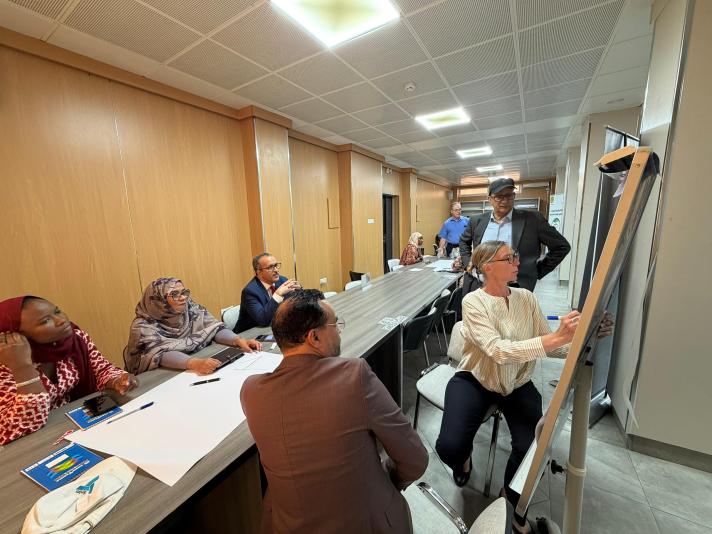
From farm to fork. Project 108 doesn’t work directly with farmers: its role is to help state control services function more effectively. Without regulation, there can be no prevention: regulation sets the rules that bind operators, and provides the foundation for inspectors’ work. Many ministries are involved (agriculture, trade, public health, customs) which makes inter-sectoral coordination absolutely central.
In concrete terms, the project is implemented by a consortium (Expertise France, France Vétérinaire International (ENSV-FVI), the University of Liège and GIZ) with national experts in each country. The work follows three stages:
- drawing up a country-by-country assessment and roadmap;
- producing health crisis management plans;
- and training trainers able to spread what’s been learned well beyond the lifetime of the project.
How will you measure success?
Not all the changes will be spectacular in the short term. But the indicators are clear: a politically validated roadmap in each country; regulatory reforms underway; crisis plans drafted and approved; trainers trained and operational. And, in the longer term, the creation of a regional network of public health actors across the ten partner countries.
The ambition is modest compared to the scale of the problem. But it is concrete: laying the foundations, strengthening capacities, and making sure State services are better equipped to safeguard public health.
*Gilles Bornert is a veterinary doctor and graduate in microbiology from Institut Pa steur. He is professor at the Val-de-Grâce military medical school, and Team Leader of P108.
Project 108: Strengthening the control and analytical capabilities to improve the security of the food chain in the Atlantic African Façade region
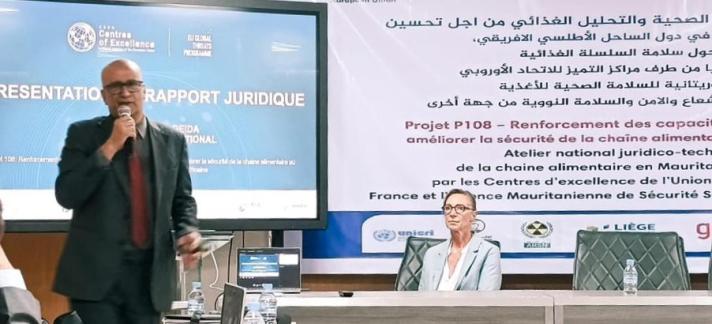
Project P108 is currently implementing a series of national technical and legal workshops across the beneficiary countries. These workshops aim to present the findings of the national assessments, discuss and validate the recommendations developed by national and international experts, and identify priorities for strengthening institutional, legal, and technical frameworks in the areas of food safety, food defense, and food fraud prevention.
To date, workshops have already been conducted in Gabon, Côte d’Ivoire, Togo, Benin, and Mauritania. The next workshop will take place in Senegal starting on 16 June, followed by activities in Cameroon in July, then Liberia, Sierra Leone, and finally Morocco.
- Publication date
- 29 June 2026 (Last updated on: 3 July 2026)
- Threat area
- CBRN Risk Mitigation
- CBRN areas
- Bio-safety/bio-security
- EU CBRN CoE Region
- AAF - African Atlantic Façade