

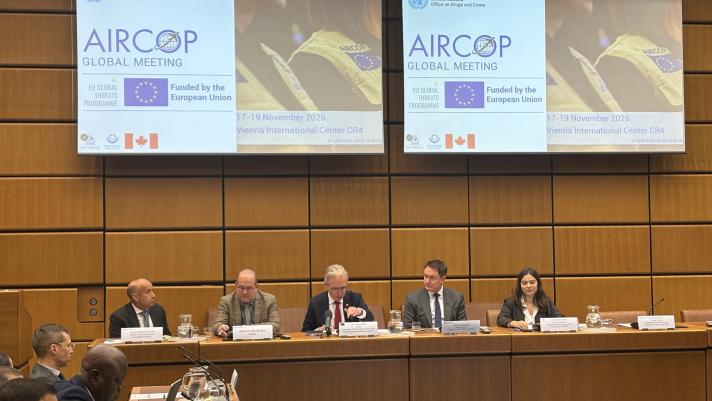
The EU-funded Airport Communication Project (AIRCOP), funded by the European Union under the EU Global Threats Programme of the European Commission’s Service for Foreign Policy Instruments (FPI), is formally coming to a close on 30 November 2026. A closing ceremony on 17 November at the UNODC headquarters in Vienna was held as part of the AIRCOP Global Meeting. The event marked 15 years of effort to strengthen security and combat illicit trafficking at international airports, and celebrated AIRCOP’s legacy while looking ahead to continued cooperation under its successor initiative, EU-INTERCEPT.
The ceremony formed part of the AIRCOP Global Meeting, “15 Years of Cooperation, Impact and Partnership”, held from 17 to 19 November 2026. Over three days, participants reflected on the project’s evolution, AIRCOP’s operational achievements and the partnerships built across regions.
The meeting brought together representatives from around 30 partner countries in Africa, Asia, Latin America and the Caribbean, alongside the European Union, Canada, INTERPOL, the World Customs Organization (WCO), UNODC, and regional bodies including the Regional Security System (RSS) and the Caribbean Community Implementation Agency for Crime and Security (CARICOM IMPACS).
From a cocaine-focused pilot programme to a global network
Launched in 2010 to counter cocaine trafficking, AIRCOP progressively evolved into a global network supporting specialised airport units bringing law enforcement authorities under one roof. At the heart of its approach was the establishment and strengthening of Joint Airport Interdiction Task Forces (JAITFs), bringing together police, customs and other law enforcement authorities to work more closely at international airports. These nationally owned inter-agency teams enable officers to share operational information, spot emerging threats and carry out coordinated cross-border interventions.
Through training, intelligence-sharing and joint operations, including WCO-led COCAIR and INTERPOL-led Harmattan Operations, AIRCOP supported partner countries strengthen cooperation along trafficking routes, moving beyond isolated national responses. Beyond operational results, the project also invested in long-term capacity development supporting trainers and mentors to embed AIRCOP tools and practices in day-to-day law enforcement work, and supported greater leadership by women officers.
Jeremy Douglas, Deputy Director of the Division for Operations at UNODC, the project’s lead implementing organisation, stressed that lasting results depend on national ownership: "Building capacities is important. Ensuring that they become part of strong, nationally owned institutions is even more important."
Speaking on behalf of the EU, H.E. Carl Hallergård, Head of the EU Delegation to the International Organisations in Vienna, highlighted the project's practical approach as a defining strength. In his opening remarks, he reaffirmed the EU’s commitment to maintain the partnerships established through the project: "We greatly value the partnerships and achievements built through AIRCOP and we hope to maintain our connections with all AIRCOP partners and explore opportunities for continued engagement through specific events and activities."
Women’s leadership at the frontline
Women officers on the frontline at airports play a critical role in detecting illicit commodities, disrupting transnational organised crime and protecting vulnerable people. With EU funding under the EU Global Threats Programme, AIRCOP has made their participation and leadership a priority.
In the airport units supported by AIRCOP in West and Central Africa, women now make up 30 per cent of officers and 32 per cent of team leaders. Through regional exchanges, workshops and peer networks the project supported women officers build technical expertise, leadership skills and professional ties across borders, contributing to more inclusive and effective border security.
Shared responsibility across borders
For UNODC, the project’s greatest achievement lies in its people. As Douglas put it: "Fifteen years ago, AIRCOP began by strengthening connections between airports. Today, its greatest achievement is the community of skilled, committed and internationally connected professionals that has developed around it." He added that "behind every figure is a story of professional judgement, operational expertise and cooperation between officers and institutions."
Throughout the meeting partners stressed the network established through AIRCOP as one of its most valuable legacy achievements. CARICOM IMPACS captured the value of timely information exchange noting that "an alert shared at one airport can enable decisive action at another one." The RSS reinforced this message of collective responsibility "We serve under different flags, but we have a shared duty."
Close cooperation with INTERPOL and the WCO further strengthened connections between national authorities with regional and international networks, facilitating information exchange across borders.
Looking ahead: paving the way to EU-INTERCEPT
As one of the longest-running partnerships between the European Union and UNODC, AIRCOP leaves behind established networks, strengthened capacities and a foundation for continued international law enforcement cooperation. Its successor, EU-INTERCEPT, will build on this experience and extend the approach beyond airports towards a multi-modal model addressing illicit trafficking across different transport routes and commodities.
The importance of adapting to evolving criminal threats was underscored by Alicia Favaretto, Project Manager at INTERPOL's Criminal Networks Sub-Directorate: "We're seeing more smuggling, more violence, more counterfeiting, and more insider threats, which are increasingly undermining societies and communities."
As AIRCOP draws to a close, the airport units, trusted relationships and cooperation built over 15 years remain in place, providing a strong foundation to build on under EU-INTERCEPT.
Project Background
AIRCOP aims to strengthen the capacities of international airports to detect and intercept drugs, other illicit goods and high-risk passengers and to share real-time operational information between origin, transit and destination countries to disrupt cross-border illicit flows and criminal networks. AIRCOP aims to build, consolidate and strengthen interdiction capacities at selected international airports in Africa, Latin America, the Caribbean and South-East Asia and to facilitate real-time transmission of operational information at regional and transregional levels, including through connection to international law enforcement databases, as well as with law enforcement counterparts at airports in the EU, building long-term formal and informal cooperation.
- Publication date
- 23 November 2026
- Threat area
- Fight against Organised Crime