

Funded by the European Union through the EU CBRN Risk Mitigation Centres of Excellence and designed for senior decision-makers, including incident commanders, senior ministry officials, and hospital leadership, the exercise tested strategic coordination and crisis governance under realistic pressure.
Chemical, Biological, Radiological, and Nuclear (CBRN) medical emergencies can begin with materials used in everyday sectors such as healthcare, agriculture, and industry, but can rapidly escalate into mass-casualty incidents if response systems are not coordinated. In CBRN events, delays in risk assessment, decontamination, triage, and public communication can increase harm to patients, responders, and nearby communities. Strengthening preparedness is therefore essential to protect lives, reduce panic, and ensure that hospitals and emergency services can act together under pressure.

Discover the full exercise gallery
Albania tests national coordination for complex CBRN medical response
On 24–25 February 2026 in Tirana, Albania, the country completed its national CBRN emergency medicine TTX, marking a milestone in the country’s efforts to strengthen preparedness for hazardous-substance incidents and mass-casualty emergencies. The training was jointly organized by the Science and Technology Center in Ukraine (STCU) and the National Emergency Medical Centres in Albania, and delivered under the EU CBRN CoE Project 88.
This action was funded by the EU through the EU CBRN Risk Mitigation Centres of Excellence. The scenario was developed jointly by Project 88 experts and Albanian Master Trainers to reflect Albania’s national priorities and operational realities. The exercise used a staged tunnel-incident scenario involving multiple vehicles, with one car carrying cesium, creating a radiological hazard. As the situation escalated, participants had to manage symptomatic casualties, contamination risks, a potentially exposed responder, and increasing media and public pressure.
What is different now: stronger national ownership and practical gap identification
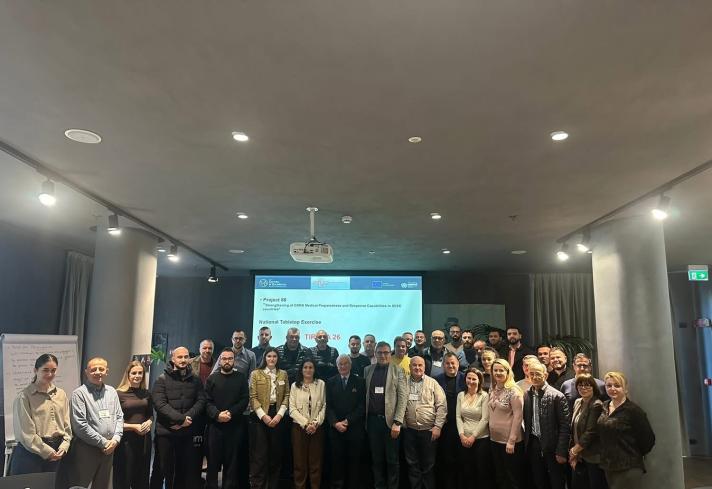
A key achievement is the shift toward stronger national ownership. Under Project 88’s 2025-2026 Action Plan, National TTXs are designed and led primarily by national Master Trainers, with mentoring from the Project experts and support from STCU. For Albania, this was more than a training event: it demonstrated the country’s growing ability to plan and manage complex CBRN medical emergency training activities independently, a critical factor for long-term sustainability.
The exercise also generated concrete operational learning. It tested command and control, incident notification and dispatch, risk assessment and escalation, casualty management, hospital readiness, public communication, and access to radiological expertise. During the “Hot Washup” and follow-up feedback session, participants identified priority improvements, including clearer lines of authority, faster toxicology support, stronger hospital readiness for contaminated casualties, and more effective crisis communication to maintain public trust.
Broad participation strengthens Albania’s whole-of-government preparedness
The exercise convened senior representatives from public health, the fire service, police, the Institute of Nuclear Physics, civil protection, three university hospitals in Albania, the National Centre of Emergency Medicine, and customs, enabling strategic coordination across the full response chain. By working through a shared scenario, these institutions practiced joint decision-making, clarified roles and responsibilities, and identified areas for improving communication and procedures before a real emergency occurs.
This national exercise also contributes to wider regional resilience. As Project 88 moves forward, similar National Table-Top Exercises are planned in other partner countries, allowing lessons learned in Albania to support future preparedness efforts across South East and Eastern Europe. In this way, Albania’s exercise stands as both a national milestone and a practical model for replication.
Project background
The training in Tirana was delivered under EU CBRN CoE Project 88, “Strengthening of CBRN Medical Preparedness and Response Capabilities in South East and Eastern European countries.” The project supports partner countries in improving medical preparedness, response coordination, and sustainable training capacity for CBRN incidents through national-level training and institutional cooperation.
- Publication date
- 2 March 2026
- Threat area
- CBRN Risk Mitigation
- CBRN areas
- Crisis management
- Safety and security
- CBRN categories
- Chemical
- EU CBRN CoE Region
- SEEE - South East and Eastern Europe