

To change that, over 120 regulators, prosecutors, judges, financial intelligence analysts and law enforcement officers from 18 Latin American countries came together in Mexico City for a Regional Conference on Virtual Assets and AML/CFT, organised by the EU Global Facility on AML/CFT, EU-funded project EL PACCTO 2.0, GAFILAT[1], the German cooperation and the Financial Intelligence Unit of Mexico.
The goal: break the silos between those who write the rules and those who enforce them, and build a shared front against crypto-enabled financial crime.
A Real Risk, Not an Emerging One
Virtual assets know no borders - and neither can the response. The FATF recognised the risks posed by virtual assets as early as 2014 and issued its first standards on the topic in 2018–2019, making it the first international body to do so. But as FATF President Elisa de Anda Madrazo told delegates in Mexico City, setting standards is only the beginning; what matters is effective implementation across every jurisdiction.
“The risks of virtual assets for money laundering and terrorist financing are no longer an emerging risk. They were a decade ago. Today, it is a real, substantive risk with growing impact.”
— Elisa de Anda Madrazo, FATF President
She outlined three core challenges that the international community must confront head-on:
- regulatory arbitrage, where criminals migrate to whichever jurisdictions have not yet acted;
- a capacity gap, as officials are pushed into unfamiliar technological territory;
- and the relentless pace of innovation, which demands that authorities and the private sector continuously update their skills.
The conference was designed to address all three at once.
For Daniel Barra Valenzuela, a specialist investigator at Chile’s national prosecutor’s office, the breadth of expertise on offer was invaluable.
“Knowledge doesn’t take up space. I am leaving with experience I can implement back home. I particularly valued the presentations from Brazil and Argentina - neighbouring countries with far more advanced practices- and the compliance perspectives I had never had on my radar before.”
— Daniel Barra Valenzuela, Specialist Investigator, National Prosecutor’s Office, Chile
Breaking Silos: Every Link in the Chain Under One Roof
What set this conference apart was its multidisciplinary design. Rather than treating regulation, supervision and enforcement as separate conversations, the EU AML/CFT Global Facility brought together every component of the AML/CFT ecosystem: regulators tasked with licensing virtual asset service providers, financial intelligence analysts tracing suspicious flows, prosecutors building cases for asset seizure, judges adjucating cases and law enforcement officers on the front lines of crypto investigations.
Sessions on beneficial ownership transparency and NGO due diligence added further depth, while a dedicated panel on investigative journalism explored the role of media scrutiny in exposing illicit financial networks.
This whole-of-system approach reflected a conviction shared across the room: virtual assets are not a niche issue for technologists. They cut across every function of the AML/CFT chain. And for participants like Héctor Napoleón Monterrosa, a prosecutor from El Salvador, the cross-cutting programme opened new horizons.
“We learned a great deal about the use of crypto-assets for terrorist financing and the development of specialised legislation, such as the EU’s MiCA Regulation. It gives us a sense of the direction our own legislation could take.”
— Héctor Napoleón Monterrosa, Prosecutor, El Salvador
Victoria Prada, a senior supervisor at Peru’s Financial Intelligence Unit, came away with an even sharper takeaway: the proof that enforcement actually works.
“I have learned how each country has faced what is, at first, an enormous challenge in implementing FATF Recommendation 15. Those best practices leave me with the message that it is possible to secure convictions, and, above all, to recover those assets and bring them back into the legal economy.”
— Victoria Prada, Senior Supervisor, FIU of Peru
Shared Challenges, Shared Solutions: EU and Latin American Partners Join Forces
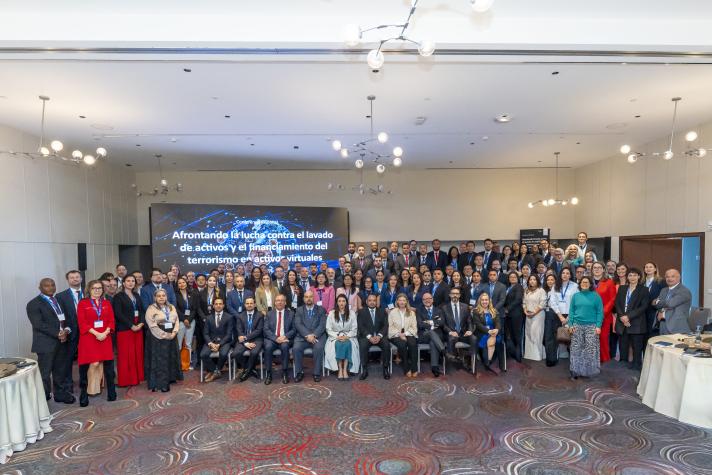
The conference was the product of a growing partnership between the EU and Latin America on anti-money-laundering and counter-terrorist-financing efforts.
For Esteban Fullin, Executive Secretary of GAFILAT, the value of the partnership lies in how it operates. Rather than importing ready-made solutions, the EU Global Facility on AML/CFT has been working on the basis of what countries in the region actually need.
“The EU Global Facility responds to demands from the region. It does not come to propose a pre-set agenda or a ready-made solution, but works based on what our countries need. And that is enormously valuable to us.”
— Esteban Fullin, Executive Secretary of GAFILAT
Fullin noted that roughly half of Latin American countries have already begun regulating the virtual asset sector, while the other half is still charting the best path forward. With GAFILAT’s fifth round of mutual evaluations now under way -in which virtual assets are assessed at the same level as traditional financial institutions- the stakes for sharing experience have never been higher.
He highlighted the importance of European and international expertise in helping the region navigate what he described as a genuinely novel regulatory challenge.
Sergio Néstor Mola, Attorney General of Argentina’s Prosecution Service, captured the spirit of the week.
“We are taking home a wealth of ideas we can apply in our work tomorrow. And we met people who will facilitate international cooperation: through formal channels, but also the informal ones that are so critical when crypto investigations demand speed.”
— Sergio Néstor Mola, Attorney General, Prosecution Service, Argentina
From the prosecutor in Mexico who summed up the event in a single word -vanguardia, staying one step ahead of criminals- to the Ecuadorian banking supervisor who stressed the need for stronger international cooperation on virtual asset oversight, the sentiment was unanimous: no country can face this threat alone, but together, a great deal is possible.
More about the EU GF AML/CFT project
In 2017, the European Commission established the EU Global Facility on AML/CFT, an operational tool to assist third countries in strengthening their AML/CFT system in line with international standards, notably recommendations from the Financial Action Task Force (FATF), EU directives on AML/CFT and United Nations Security Council resolutions.
This project aims to support third countries in their efforts to prevent money laundering and cut off access to funding for individual terrorists and terrorist organisations, in line with international standards.
Download the project factsheet
[1]GAFILAT is the FATF-Style Regional Body for Latin America
- Publication date
- 13 March 2026 (Last updated on: 19 March 2026)
- Threat area
- Counter-Terrorism, Prevention of Violent Extremism
- Fight against Organised Crime