

A suspicious powder was dispersed at a border crossing. Victims, officers, and apprehended suspects require emergency decontamination. Operational investigations lead to a clandestine laboratory. Crime scene teams conduct investigations under CBRN conditions. On 25-26 May 2026, this scenario became an operational reality in Lusaka, Zambia*
The significance lay in continuity. Most of these border officers, customs officials, police, military and forensic investigators from Burundi, DRC, Ethiopia, Ghana, Kenya, Malawi, Seychelles, Tanzania, Uganda, and Zambia* had trained together in Mombasa exactly one year earlier.
The Lusaka exercise tested whether that foundation held, and whether they could advance to more complex operations.
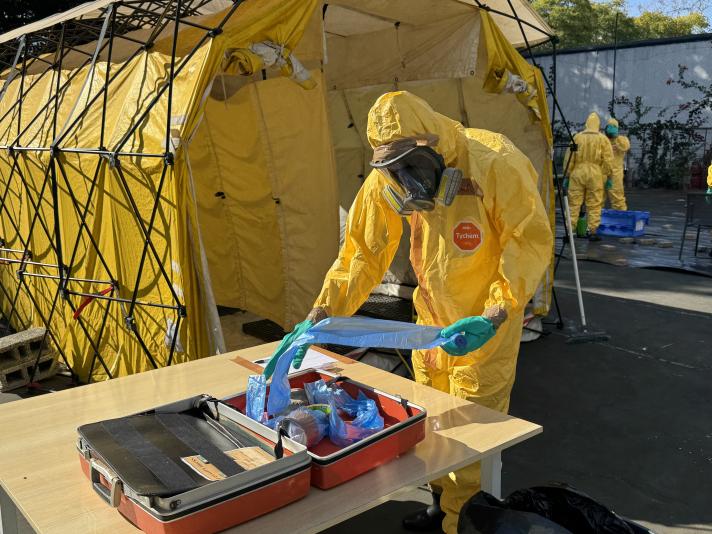
Learning by Doing: Why Simulations Matter
Marian Kolencik, Lead Trainer for P106 and Founder of the ISEM Institute, explained the crucial importance of simulations.
When you're listening to presentations, you retain only a small percentage. When you're in the field executing procedures with actual tools, cooperating with others: that's the only way to improve. You can teach strategy in workshops, but operational and tactical expertise only comes from doing it," he added.
The exercise, which was held after several days of intensive training and rehearsal, aimed at testing participants’ readiness to deal with a multi-location, multi-agency biological incident under time pressure. From suspect apprehension in contaminated areas to decontamination escort procedures and conducting CSI, the scenario demanded real-time problem-solving under pressure.
Across two locations, participants in mixed teams had to function as a single unit, through a scenario built to stress-test what they learned and practiced.
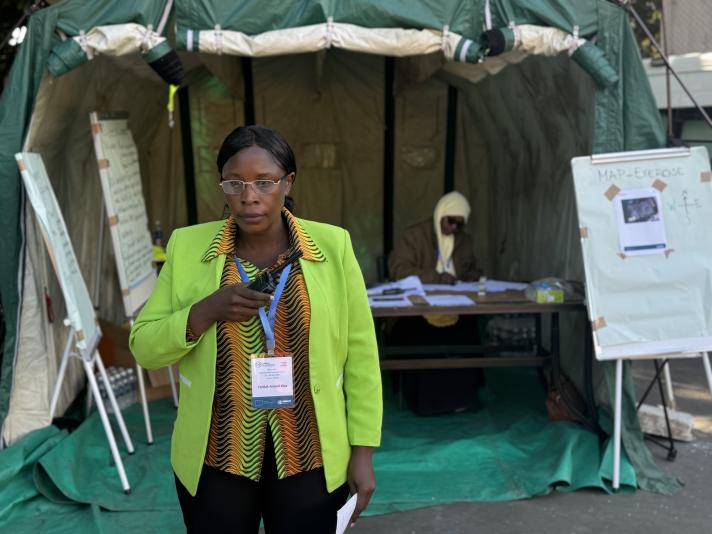
Samira Maulid, a veterinary inspector with Tanzania's Ministry of Livestock and Fisheries who participated in both the Mombasa and Lusaka exercises, captured the shift: "Last year, I learned theory. This year I saw coordination in practice. In my country, police work separately, customs work separately. Here, we saw how it should function. I'm determined to make this happen at home."
For Joris Sprokholt, P99 Key Expert and senior scientist at the Dutch National Institute for Public Health and the Environment, communication between countries and response teams was excellent.
The challenge isn't willingness; it's that CBRN incidents are infrequent, so you need regular exercises like this one to keep procedures embedded.
Joris Sprokholt, P99 Key Expert
Petra Gasparova, Deputy Head of the EU Delegation to Zambia, underscored what the exercise demonstrated at a regional level: "When a Kenyan customs officer needs guidance, a Tanzanian biosecurity expert can be there. This is the CBRN Centres of Excellence Initiative working as designed."
She added that the investment behind such training is anything but optional: "The training, the equipment, the expert facilitation, the opportunity to practice under realistic conditions: these are not luxuries. They are necessities."
The Missing Piece: Policy and Classification
Operational success revealed a critical gap. Most East and Central African countries lack formal classifications of dual-use biological materials and dual-use research of concern (DURC). Without these definitions, border and law enforcement officials cannot effectively enforce controls on potentially hazardous materials crossing national boundaries.
Sprokholt framed the issue clearly: "You need three components. First, classification of dual-use materials and DURC. Second, awareness among scientists and facilities. Third, operational execution capacity. This exercise addressed the third. But without the first two, enforcement remains incomplete."
Danny Malambo, Zambia's Deputy National Focal Point, reflected this understanding: "As a country, Zambia has progressed significantly in detection, response, and reconnaissance. But this exercise showed what we need at the policy level: the enabling environment for enforcement."
When evaluations concluded on 26 May, the outcome was measurable: 22 professionals returned to their countries with advanced operational capacity, strengthened regional networks, and clear identification of policy priorities. That foundation, built on a year of consistency, tested under pressure, and grounded in identified gaps, shapes the next phase of regional CBRN cooperation.
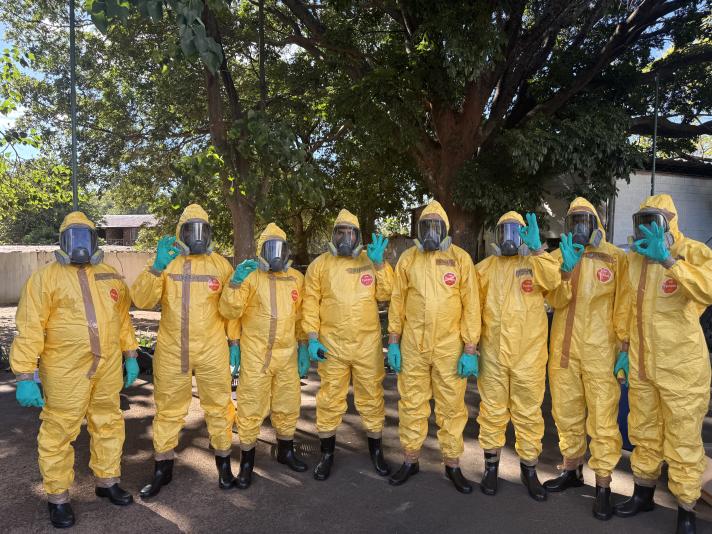
Discover the exercise full gallery
About the European Union CBRN Risk Mitigation Centres of Excellence Initiative
The EU CBRN CoE is a global initiative funded and implemented by the European Union to promote peace, stability, and conflict prevention. It aims to strengthen all-hazards security governance in partner countries through a voluntary, needs-based approach. The initiative, led by the European Commission's Service for Foreign Policy Instruments (FPI) in coordination with the European External Action Service (EEAS), brings together 63 countries working at regional and international levels. The network supports CBRN risk mitigation by fostering good governance, enhancing multi-agency cooperation, and facilitating the transfer of best practices, ensuring that support is tailored to countries' specific needs.
*Although part of the project’s partner countries, Rwanda did not participate in this exercise.
- Publication date
- 29 May 2026 (Last updated on: 2 July 2026)
- Threat area
- CBRN Risk Mitigation
- CBRN categories
- Biological
- EU CBRN CoE Region
- ECA - Eastern and Central Africa