

A week focused on action, trust and the rule of law
This year’s edition opened with a clear message: fighting organised crime is not only a matter of enforcement, but also of legitimacy, public trust and institutional resilience.
Opening remarks from Peter Wagner, Director of the Service for Foreign Policy Instruments at the European Commission, alongside Michael Schmid, President of Eurojust, and Peter Jozsef Csonka, Acting Director for Justice Policies at the European Commission, highlighted the need for stronger and more agile global cooperation against converging criminal threats.
Our hope is that we continue to contribute, significantly and in a tangible way, to addressing the challenges that all of us are facing.
Peter Wagner, Director of the Service for Foreign Policy Instruments at the European Commission
In his keynote address, former president Carlos Alvarado Quesada set the tone for the week, underlining that fighting organised crime is not only a matter of legitimacy, but also public trust and institutional resilience. Effective responses must protect communities, preserve rights and reinforce the institutions that criminal groups seek to undermine.
Technology is important, laws are important, policing is important but, perhaps, when fighting transnational organised crime what is most important is international cooperation, collaboration, and trust to get results.
Carlos Alvarado Quesada, Former President of Costa Rica and President of the Latin American and Caribbean Group on Security and Democracy

Rule of law as the foundation for security
Participants examined organised crime through the lens of rule of law, focusing on the resilience of criminal drug markets, violence and community engagement.
Discussions underlined that organised crime is both a security threat and a governance challenge, requiring criminal justice responses that strengthen prevention, institutional cooperation and engagement with and protection of affected communities.

Four new EU actions against organised crime
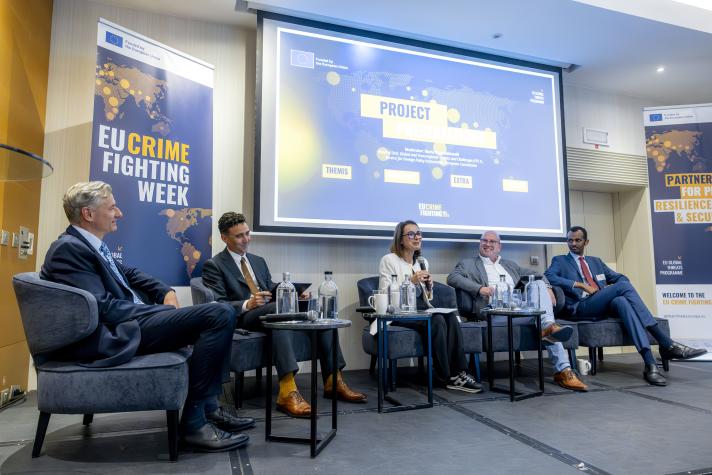
A dedicated session presented four new EU actions: Themis, Intercept, EXTRA and Polaris. Together, they point to the breadth of the integrated response being put forward: political action and public awareness, robust law enforcement and criminal justice capacities, efficient control of trafficking routes, all informed by up-to-date professional analysis of the threats.
Evolving threats and technology-driven responses
Interactive workshops on cyberattacks and foresight, including responses to a fictional organised crime cyberattack scenario and an exercise on the future of organised crime, reflected on three connected realities:
- Organised crime is no longer confined to traditional trafficking routes or single illicit markets.
- Criminal networks move across physical and digital spaces, combining legal and illegal activities.
- New technologies including AI, financial systems, and cross-border vulnerabilities are being exploited to recruit, deceive, move assets, and conceal criminal activity.
Technology is not only a threat multiplier, but also a part of the response. Digital tools must support investigations, improve information-sharing and strengthen detection capacities.
Fighting crime effectively in the digital era requires a coordinated effort between public authorities, private companies and international partners, while ensuring that access to electronic evidence, artificial intelligence, and investigative technologies remains anchored in legality, accountability and public trust.
From discussion to delivery
Across three days, participants examined organised crime from different angles: drug markets and trafficking routes, community resilience, cybercrime, and responsible use of technology. The launch of Themis, Intercept, EXTRA and Polaris connected these discussions to concrete areas of action, reinforcing the need for integrated, evidence-based and accountable responses.
- Publication date
- 18 June 2026
- Threat area
- Fight against Organised Crime
- Events
- EU Crime Fighting Week 2026