

A trafficking corridor under pressure
The Dominican Republic sits at a strategic crossroads of two distinct flows: inbound mobility from neighbouring producing countries, and outbound containerised shipments destined mainly for Europe. As enforcement pressure has intensified on certain ports across the Americas, criminal organisations have rerouted, pushing more drugs through the Caribbean, with the Dominican Republic increasingly used as a departure platform for the European market.
That displacement effect is precisely what cross-regional training is designed to disrupt. A trafficker who reroutes from one port to another should not find a weaker enforcement response on the other side.
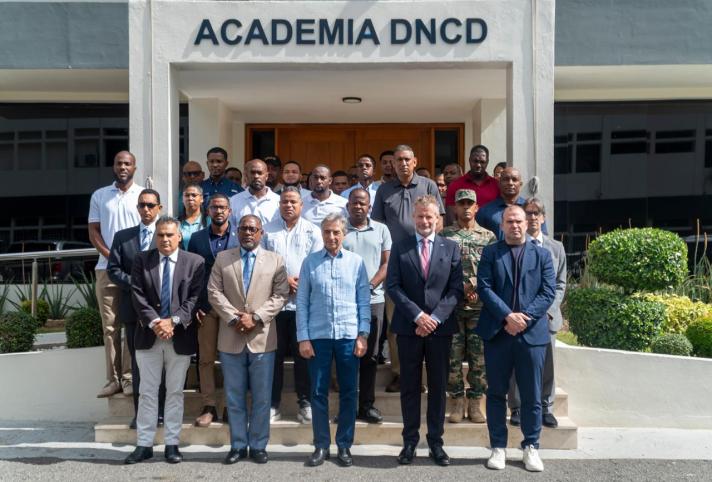
In May 2026, SEACOP VI - the EU-funded Seaport Cooperation Project working to counter maritime drug trafficking across Latin America, the Caribbean and West Africa- partnered with the Dominican Republic's Dirección Nacional de Control de Drogas (DNCD) to deliver a five-day cross-regional training in Santo Domingo.
Twenty officers took part: ten from Dominican agencies, five from Trinidad and Tobago's Transnational Organised Crime Unit, and five members of the Barbados Coast Guard.
The Caribbean officers were not there by chance. They had earned their seats by winning the 2025 SEACOP JMCU Competition, a regional contest that turned a familiar capacity-building problem into an opportunity.
Classroom, tabletop, live vessel
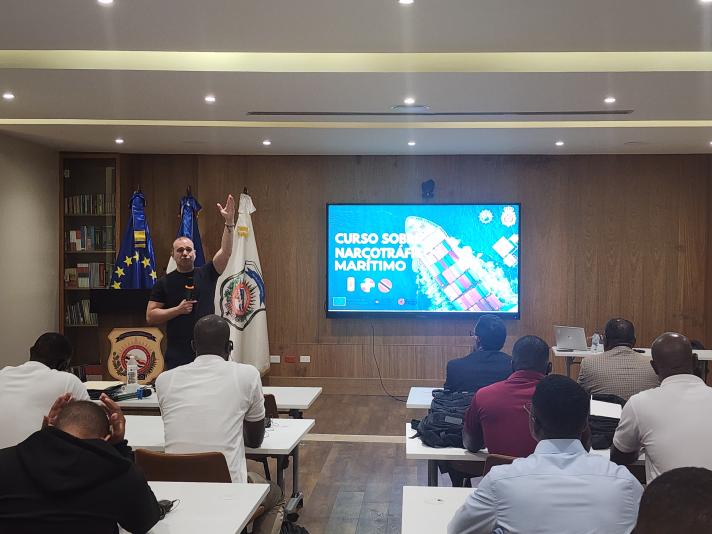
Over five days, participants moved through the full methodology:
- Theoretical modules on regional threat dynamics, on the architecture of vessels exploited by criminal groups, and on the strategic distribution of material, naval and human resources used to carry out illicit operations.
- Inter-agency, cross-regional teams analysed operational scenarios drawn from real intelligence reports, working against the clock to plan their response.
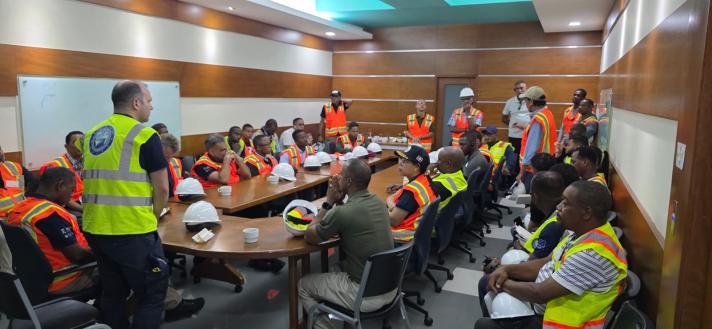
The training culminated in a timed practical exercise on board a live cargo vessel at the Port of Haina: a full rummage requiring teams to assign roles, apply safety procedures, examine onboard documentation, and weigh possible outcomes under operational pressure.
“This operational training shows both the commitment of the teams on the ground in the Caribbean and the key importance of information sharing and good practices exchanges between all regional stakeholders, without forgetting the role played by EU Member States in this global fight against trafficking,” concluded Dominique Bucas.
Why a maritime security competition to start with?
In most SEACOP beneficiary countries, Joint Maritime Control Unit (JMCU) members serve permanently within their parent agencies -Navy, Police, Customs, Coast Guard- and rarely train alongside colleagues from other services. Resourcing is the obstacle: a fully-funded, multi-agency facility remains out of reach for many states.
The JMCU Competition was designed as an innovative response to that gap: a mechanism to consolidate the region's JMCUs into composite units that come together for sustainable, annual refresher training. By rewarding excellence with operational exposure, it gives winning teams something difficult to access at home: time alongside counterparts from another country, working through identical scenarios on unfamiliar vessels.
For SEACOP's Caribbean Regional Coordinator, the value of training in this format goes beyond technical skill:
"Language and cultural barriers cannot be surpassed solely by smartphone translation apps. Joint regional teams can't effectively perform as an integrated team unless information is shared: freely, explicitly, and physically through demonstration and rehearsal. None of this can happen until trust is built by taking the time to engage and share lessons learned: in the classroom, in breaks, and after hours." — Jason Kelshall, Caribbean Regional Coordinator, SEACOP
EU presence on the ground
The EU Ambassador to the Dominican Republic attended the opening ceremony, underlining the importance of regional and global cooperation in confronting a threat that ultimately reaches European shores.
“What participants will take home is not only technical: it is a wider operational network, an understanding of how a neighbouring country structures its response, and the kind of personal contacts that allow information to move quickly when an investigation cannot wait for formal channels,” concluded Dominique Bucas.
In a trafficking economy that moves across borders by design, that is precisely the response a transregional project like SEACOP is built to deliver.
More about SEACOP
SEACOP is an EU-funded initiative working since 2010 to counter maritime drug trafficking and transnational organised crime across more than 30 partner countries in Latin America, the Caribbean and West Africa.
Through a transregional approach, SEACOP supports the creation and mentoring of Joint Maritime Control Units (JMCUs) and Maritime Intelligence Units (MIUs), strengthens international cooperation on maritime intelligence, and builds the operational and analytical capacity of partner countries to disrupt trafficking routes, including those leading to European ports.
Funded by the European Commission's Service for Foreign Policy Instruments (FPI) under the EU Global Threats programme, the project is implemented by Expertise France and FIAP.
- Publication date
- 21 May 2026
- Threat area
- Fight against Organised Crime