

The opening session was marked by the presence of Maria Rosa Sabbatelli, Head of Unit at the European Commission’s Service for Foreign Policy Instruments, underlining the European Union’s strong commitment to supporting crisis management and institutional resilience in the region.
Bringing together mid-level practitioners from Kazakhstan, Kyrgyzstan, Tajikistan and Uzbekistan, alongside experts from EU institutions and Member States, the seminar reflected a comprehensive, multi-agency approach.
Participants represented key elements of the crisis response chain, including coordination centres, specialised intervention units, rescue services, investigative bodies and prosecution authorities. For Uzbekistan, participants were drawn from institutions such as the State Security Service, the Prosecutor General’s Office, the Ministry of Internal Affairs, the National Guard and the Law Enforcement Academy.
Building on lessons learned
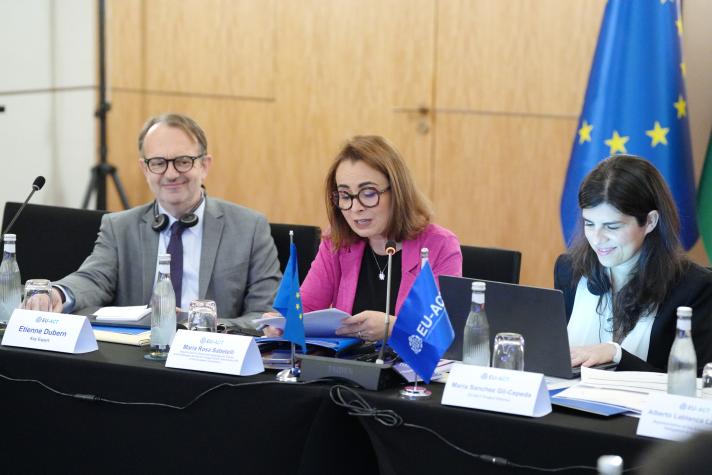
This seminar builds on three workshops held in 2025—“Before the crisis”, “During the crisis” and “After the crisis”—and aims to consolidate lessons learned by focusing on the planning, conduct and evaluation of complex multi-agency exercises. Through practical sessions, participants explored the full exercise cycle, from scenario design to evaluation, and exchanged experiences in a regional setting.
A core message of the seminar is that effective crisis preparedness requires more than plans and legislation. Complex exercises are essential tools to test coordination, reveal gaps and improve institutional performance under pressure.
The seminar also responds to evolving security challenges in Central Asia, including terrorism, regional instability and the need to secure public spaces and major events. With upcoming international sporting events such as the FIFA Series 2026 matches and the FIFA U-20 World Cup in 2027, strengthening preparedness has become increasingly important.
More about EU ACT II
EU ACT II (EU action against organised crime and terrorism) aims to increase the effectiveness of efforts in combatting illicit trafficking, smuggling and organised crime as well as to disrupt the terrorist networks and bring criminals to justice while continuing to respect human rights, gender equality and the rule of law.
Active until 30 May 2028, the project is implemented by FIAP, in partnership with Carabinieri and CIVIPOL.
Details
- Publication date
- 21 May 2026
- Authors
- Service for Foreign Policy Instruments | European Union Institute for Security Studies
- Threat area
- Counter-Terrorism, Prevention of Violent Extremism
- Fight against Organised Crime