

By investing in sustainable national institutions, the initiative helps prosecutors and forensic specialists respond to the evolving digital dimensions of terrorism.
Today’s terrorism investigations increasingly rely on digital evidence. Mobile phones, computers, encrypted communications and cloud-based data have become essential for identifying suspects, reconstructing events and securing convictions. To be effective in court, this evidence must be lawfully identified, collected, preserved, analysed and presented.
Funded by the European Union and implemented by the United Nations Office of Counter-Terrorism (UNOCT), the EU–UN Global Terrorism Threats Facility provides tailored assistance through expert advisory support, specialised training and targeted equipment provision. Following a request from the General Prosecutor’s Office of the Republic of Tajikistan, the Facility launched a support package to strengthen digital evidence capacities across the criminal justice chain—from forensic examination to prosecution in court—in partnership with the General Prosecutor’s Office and the Ministry of Justice.

Building sustainable national capacity
Building sustainable digital evidence capacity requires more than technical training. It requires national institutions to develop their own expertise, training systems and practical infrastructure. Rather than delivering stand-alone activities, the Facility combines expert advisory support, tailored training and targeted equipment provision to help national institutions build lasting capacity.
Over the past year, experts from the Facility worked closely with the Institute of Prosecutorial Development under the General Prosecutor’s Office to co-design Tajikistan’s first dedicated training programme on the use of digital evidence in terrorism-related investigations and prosecutions. Rather than introducing an off-the-shelf curriculum, the course was jointly developed with Institute lecturers to reflect Tajikistan’s legal framework, prosecutorial practice and operational priorities.
Through a series of advisory and mentoring missions, the course was jointly developed, tested and validated. At the same time, the Institute and the Facility established a dedicated digital forensics training classroom equipped to support practical exercises and enable the Institute to deliver the programme independently.
Approved by the Prosecutor General for inclusion in the Institute’s regular curriculum, the course has become part of Tajikistan’s institutional framework for training and professional development of prosecutorial personnel, including trainees and other young professionals.

From the crime scene to the courtroom
The newly developed five-day training course brought together 22 prosecutors from across Tajikistan for an intensive combination of lectures, practical exercises and case-based learning.
Rather than studying individual topics in isolation, participants followed a realistic terrorism investigation from the moment digital devices were discovered through forensic examination, prosecutorial analysis and ultimately courtroom presentation. Each practical exercise built upon the previous one, allowing participants to experience how digital evidence moves through every stage of a criminal investigation.
Participants learned to identify, collect, preserve and present digital evidence, work effectively with forensic experts, analyse forensic reports and apply digital evidence in court proceedings. The programme also covered mobile device seizure, chain of custody, open-source information, artificial intelligence, and the integration of human rights, gender and victim-centred approaches throughout the investigation process.
Investing in sustainable national capacity
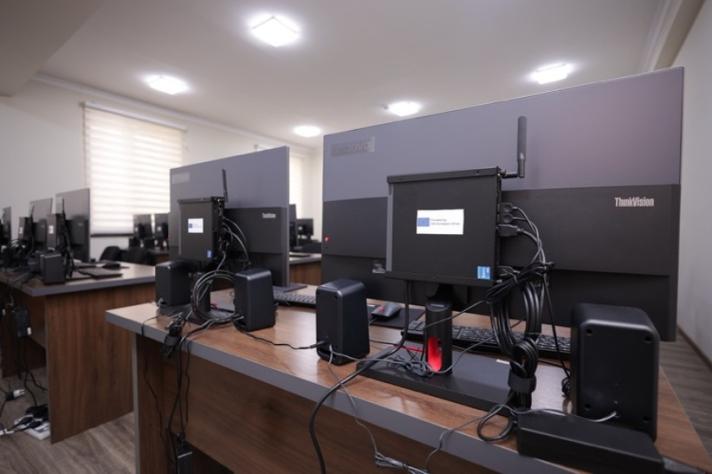
The pilot course culminated in the official inauguration of a dedicated digital forensics training classroom and the handover of IT and specialised digital forensics equipment provided through the Facility. The classroom is now equipped with 20 trainee computer workstations, a lecturer workstation, an interactive display, printer, and specialised digital forensics hardware and software designed specifically for practical prosecutorial training.
“The use of digital evidence has become an essential component of modern criminal investigations. The establishment of this training classroom and the integration of the new course into the Institute’s curriculum will strengthen the capacity of prosecutors across Tajikistan to effectively investigate and prosecute terrorism-related cases.”
Mr. Kurbonzoda Sharif Habibullo, Director of the Institute of Prosecutorial Development of the Republic of Tajikistan
The new classroom enables prosecutors to move beyond theory and develop practical skills through realistic investigative scenarios using the same methodologies and technologies they are likely to encounter in their professional work. More importantly, it provides the Institute with a permanent national capability to independently deliver practical digital evidence training in the years ahead.
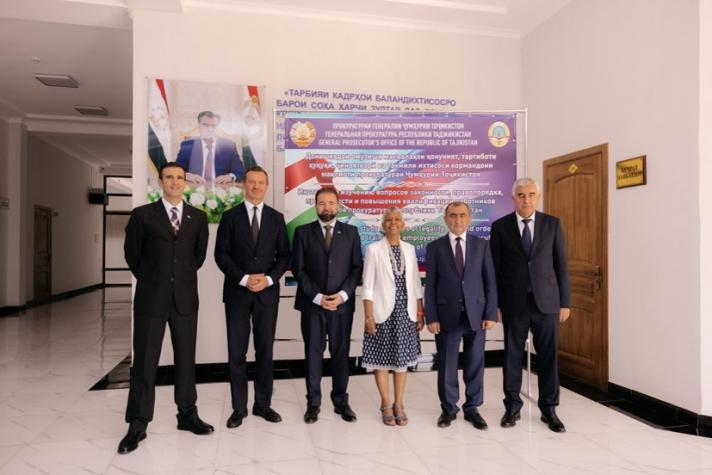
The inauguration and equipment handover ceremony on 15 July 2026 brought together representatives of the General Prosecutor’s Office, the European Union, the United Nations and national partners, reaffirming their shared commitment to strengthening Tajikistan’s capacity to investigate and prosecute terrorism-related offences in an increasingly digital environment.
“In the digital age, terrorism knows no borders — neither should justice. By equipping Tajikistan with cutting-edge digital forensics tools and expertise, the EU–UN Global Terrorism Threats Facility, funded by the European Union, turns the tide against online extremism, ensuring evidence stands strong in court, and forging a united front to uphold the rule of law. This is a shared commitment to stay ahead of evolving threats — together.”
Mr. Ferdinand Jenrich, Deputy Head of the EU Delegation to Tajikistan
Putting new skills into practice
As an Assistant Prosecutor in Rasht District, Ms. Shodona Subhonzoda is increasingly encountering investigations involving mobile phones, online communications and other forms of digital evidence. For prosecutors working at the district level, understanding how digital evidence is collected, analysed and presented has become an increasingly important part of day-to-day prosecutorial work.
For Ms. Subhonzoda, the value of the training extended well beyond learning new investigative techniques. The practical exercises demonstrated how digital evidence should be handled throughout the criminal justice process—from lawful collection and preservation to forensic examination and courtroom presentation—while strengthening cooperation between prosecutors and forensic specialists.
“Participating in the new training course on digital evidence for prosecutors was a highly valuable professional experience. As assistant prosecutor in Rasht, I increasingly work with cases involving mobile phones and online communications. This training gave me both the confidence and the practical tools to handle that evidence properly — to collect and preserve it lawfully, work effectively with forensic experts, and present it convincingly in court.
Looking ahead
The pilot training marks an important milestone in the European Union’s broader partnership with Tajikistan to strengthen national capacities to address evolving terrorist threats through sustainable institutional development.
During the second half of 2026, the Facility will continue supporting the establishment of a dedicated digital forensics laboratory within the Republican Centre for Forensic Expertise and Criminology under the Ministry of Justice, while providing continued expert mentoring and advisory support. Together with the newly institutionalised prosecutors’ training programme, these complementary initiatives will further strengthen Tajikistan’s capacity to use digital evidence across the criminal justice chain—from forensic examination to effective prosecution in court.
About the EU-UN Global Terrorism Threat Facility
Implemented by the UN Office on Counter-Terrorism (UNOCT), this EU Global Threats programme project aims to support States in enhancing their capacities to address the terrorist threat, disrupt terrorist networks, prevent and counter the activities of terrorists and bring them to justice in compliance with international law, human rights and the rule of law, and while advancing gender equality.
- Publication date
- 29 July 2026
- Threat area
- Counter-Terrorism, Prevention of Violent Extremism