

Funded by the European Union under the EU CBRN Risk Mitigation Centres of Excellence (EU CBRN CoE), they tested the architecture of Uzbekistan’s national crisis coordination for the first time at this scale.
Testing readiness where it matters most
The scenario was deliberately unforgiving. A simultaneous chemical and radiological attack. A mass gathering at Samarkand’s Dynamo Football Stadium. Suspects still at large. Misinformation and panic spreading fast.
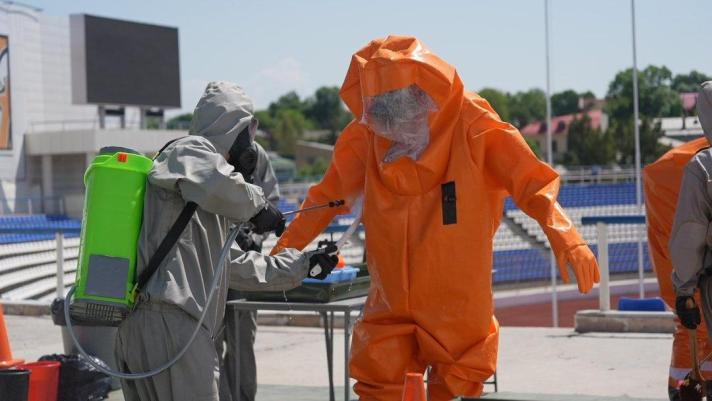
Within a tight timeframe, teams of responders from multiple Uzbek agencies had to detect and neutralise hazardous materials, secure the perimeter, apprehend suspects, decontaminate casualties, coordinate evacuation, and manage a surge of media interest. Over 400 people were present at stadium as participants, role-players and exercise controllers.
Visit the exercise full gallery
From planning to the field: a year in the making
Exercise Dinamo was the result of a year-long preparatory programme, where Uzbek and EU CBRN CoE experts collaborated closely to ensure optimised strategic alignment and, ultimately, a successful exercise.
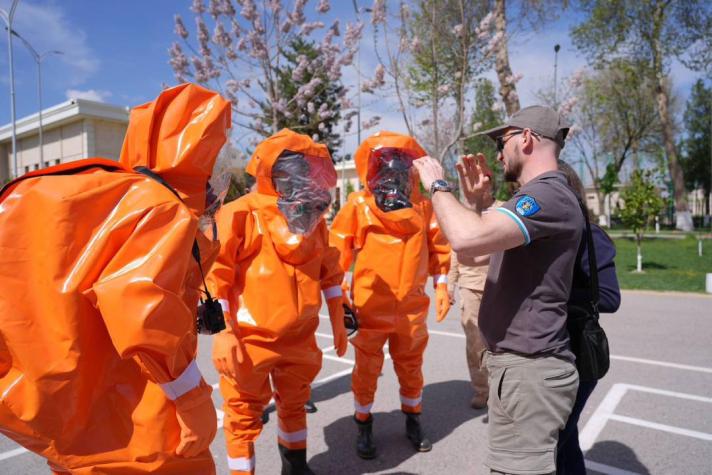
Before the teams were deployed to the stadium, all participating agencies gathered for a tabletop exercise and a focused inter-agency drill, designed to align procedures, stress-test communication lines, and identify bottlenecks to be addressed before they could become critical points of failure.
On 29 April, the exercise reached its operational climax, when first responders, decontamination teams, bomb disposal specialists, and medical personnel worked in concert on the stadium ground. The exercise was not merely a test of individual agencies’ response capacity, but of something more complex and harder to train but vital for success: interagency co-ordination.
On 30 April, a structured evaluation of the exercise was held to identify lessons for future capacity building. In addition, a regional workshop attended by teams from across the Central Asia region of the EU CBRN CoE network reviewed the implications of the exercise and examined good practice in managing public communications and dealing with disinformation.
A decade of partnership
Since 2015, the EU CBRN CoE network has supported Uzbekistan through planning conferences, site visits, and training for over 200 responders across 17 projects, while also facilitating regional knowledge exchange among Central Asian partner countries.
Exercise Dinamo reflects a deepening EU-Uzbekistan partnership for civil security and public safety. As Uzbekistan prepares to host an increasing number of major international events, the capacity to coordinate a comprehensive CBRN response is an operational necessity. And that’s where the EU CBRN CoE come in.
Co-building global resilience with the EU CBRN CoE
Developed under the EU CBRN CoE as part of the EU Global Threats programme, and with the support of the United Nations Interregional Crime and Justice Research Institute (UNICRI), exercise Dinamo is part of a broader effort to strengthen global CBRN capabilities.
"Being part of the CBRN CoE network makes a real difference on the ground”, said Mr.Abduvakkos Rafikov, Head of the Uzbek Committee for Industrial, Radiation and Nuclear Safety and Head of the Regional Secretariat for Central Asia. “Our responders are better trained, and better connected to their counterparts across agencies. Exercise Dinamo showed us how far we have come, and where we can still go."
As April 26 marked the 40th anniversary of the Chornobyl nuclear disaster, exercise Dinamo reflects an enduring commitment to collaborate for CBRN preparedness. Its findings will feed into policy, training, and future exercises, strengthening national and regional resilience for years to come.
- Publication date
- 4 May 2026
- Threat area
- CBRN Risk Mitigation
- CBRN areas
- Post incident recovery
- Public and infrastructure protection
- Public health impact mitigation
- Safety and security
- CBRN categories
- Biological
- Chemical
- Nuclear
- Radiological
- EU CBRN CoE Region
- CA - Central Asia