

Chemical, biological, radiological and nuclear (CBRN) threats continue to pose complex and evolving risks to public safety, national security and international stability. As the peaceful use of hazardous materials expands across health, industry and research sectors, so too does the need for robust national frameworks to prevent misuse, accidents and illicit trafficking. Strengthening preparedness, coordination and response capacities is therefore essential to mitigate CBRN risks and uphold global non-proliferation commitments.
Against this backdrop, Kenya reaffirmed its strong commitment to global non-proliferation and national security with the official launch of its CBRN National Action Plan on 27 November 2025 at the Administration Police Training College in Embakasi, Nairobi.
Speaking at the event, Dr. Raymond Omollo, Principal Secretary for Internal Security and National Administration, emphasized Kenya’s adherence to international obligations under UNSCR 1540, the Chemical Weapons Convention (CWC), the Biological Weapons Convention (BWC) and the Nuclear Non-Proliferation Treaty (NPT).
“As peaceful use of CBRN materials expands, Kenya recognizes the increasing risks of diversion, accidents, and misuse,” Dr. Omollo noted, underscoring the country’s dedication to ensuring that dangerous materials are used safely, securely, and solely for peaceful purposes.
The event brought together key national and international stakeholders, including Mr. Ondrej Simek, Deputy Head of Mission at the EU Delegation to Kenya; Mr James Keter, Director General of Kenya Nuclear Regulatory Authority, Mr. Gilbert Masengeli, Deputy Inspector General of the Administration Police Service; Dr. Richard Lesiyampe, CEO of Kenyatta National Hospital; and representatives from Ministries, Departments, and Agencies.
Through sustained support from the European Union and coordinated efforts by the multisectoral CBRN National Team, Kenya has significantly enhanced its technical capacity and readiness to manage CBRN threats. The CBRN National Focal Point, Mr. William Munyoki, who also serves as the Government Chemist, led the development of the National Action Plan alongside experts from Kenya Medical Research Institute, Ministry of Health, Kenya Revenue Authority, NACOSTI, Kenya Bureau of Standards, National Environmental Management Authority, Kenya Wildlife Service, Directorate of Veterinary Services, National Public Health Laboratories, Directorate of Criminal Investigations and National Disaster Management Unit.
This integrated Plan aligns with the Constitution of Kenya, national disaster-management strategies, and relevant international conventions, ensuring a coordinated national approach to preventing, detecting, and responding to CBRN risks.
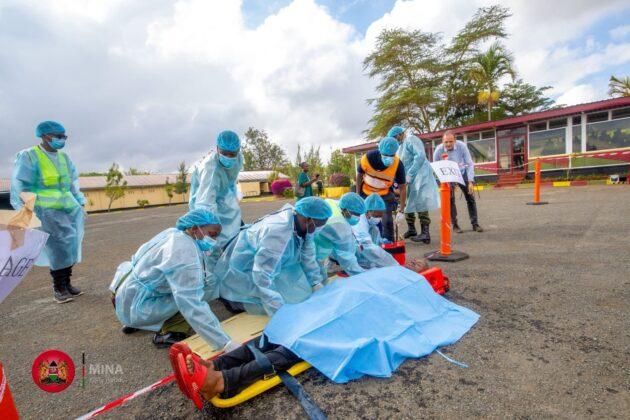
The highlight of the launch was a spectacular live simulation demonstrating multi-agency response to a chemical emergency. The exercise—executed by experts trained through the EU CBRN Centres of Excellence and other international partners—showcased step-by-step procedures required to save lives and secure hazardous scenes. Participating agencies included Kiambu and Nairobi County Fire Departments, Government Chemist Department, Kenya Council of Emergency Medical Technicians, National Disaster Management Unit, Directorate of Criminal Investigations, Administration Police Service, National Disaster Operations Centre, St. John’s Ambulance and Ministry of Interior. These exercises aim to build awareness of roles, procedures, and planning processes necessary for effective first-responder preparation during real CBRN emergencies. The EU CBRN CoE Initiative Project 102 will support practical elements of the emergency response plans through provision of specialised equipment in 2026. Incorporation of the National CBRN Emergency Response Plan (developed under Project P17) into the National Disaster Risk Management Bill, 2023 would be a boost to overall CBRN risk mitigation.
Kenya’s experts have taken part in numerous projects under the EU CBRN Centres of Excellence, contributing to advancements in legal frameworks, biosafety, biosecurity, chemical safety, nuclear security, and emergency response. Key projects include: P17 – Establishing a National Response Plan in Ghana and Kenya for responding to unauthorised events involving chemical, biological, radiological and nuclear materials, P33 – Strengthening the national CBRN legal framework and provision of specialized and technical training to enhance CBRN preparedness and response capabilities in Eastern and Central Africa, P42 – Chemical Safety and Security in the Central and Eastern African region, P60 – Support to the EU CBRN Centre of Excellence of Eastern and Central Africa in Nuclear Security, P66 – MEDISAFE – Combating illicit traffic and enhancing the safety of medicines in Eastern and Central Africa, P99 – Strengthening Biosafety and Biosecurity Capabilities in East and Central Africa, P102 – Provision of specialised equipment to the EU CBRN CoE Partner Countries in Africa, P106 – Table Top Exercises, Simulations and Trainings for CBRN risk mitigation (TEST), P111 – Strengthening management of chemical waste in East and Central Africa.
With the formal endorsement of the CBRN National Action Plan, Kenya joins Malawi, Rwanda, and Tanzania in strengthening regional CBRN risk-mitigation frameworks. In 2026, the CBRN national team will embark on awareness raising campaigns through county governments and community engagement, ensuring that the Plan is understood, tested, and refined for effective national implementation. Mr Simek expressed the EU’s appreciation of the leadership in CBRN risk mitigation and reiterated continued support through various partnerships.
Kenya’s launch of the CBRN National Action Plan marks a major milestone, demonstrating the country’s unwavering commitment to safeguarding its citizens, environment, and regional neighbours from CBRN risks—while upholding global peace and security frameworks.
- Publication date
- 27 November 2025 (Last updated on: 9 January 2026)
- Threat area
- CBRN Risk Mitigation