

Climate change in South East Asia is not just an environmental crisis; it is a driver of existential challenges to the resilience of its economies and societies.
Last week's Bangkok Climate Security Dialogue, organised by the European Commission’s Service for Foreign Policy Instruments (FPI) and supported by adelphi global, convened more than 40 regional actors, including national and local authorities, ASEAN, the Mekong River Commission, the Mekong Institute, EU and UN agencies, civil society and researchers, to share good practices, strengthen cooperation and develop actionable recommendations for policy and programming.
The event opened with remarks from Maria Rosa Sabbatelli, Head of Unit for Global Security at FPI and a keynote from Anoulak Kittikhoun, Executive Director and CEO of the Mekong Institute.
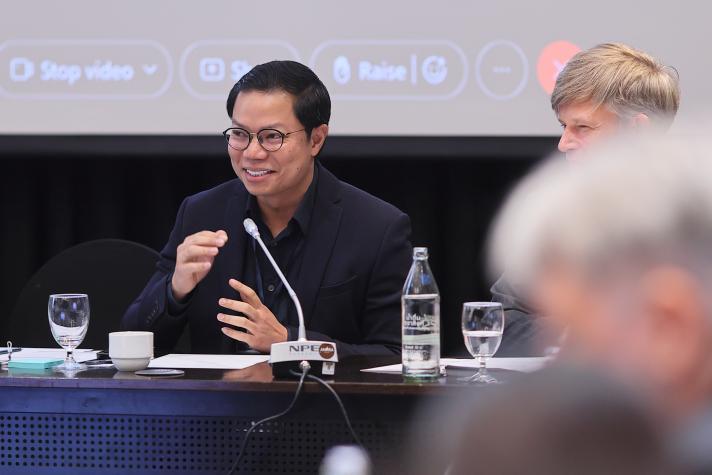
Key takeaways from two days of forward-looking discussion include:
- Although there have been significant investments into Early Warning Systems in South East Asia, including through the EU and UNDRR, there is scope for better linking these up into multi-hazard decision support systems that can help policy-makers address risks more systematically.
- Beyond early warning, gaps in knowledge and awareness of the impending impacts mean that responsibility for the necessary responses in terms of adaptation and prevention is often insufficiently clearly allocated and prioritized.
- It is important to ensure that responses reduce and remove risks, rather than just transferring them to other (often more vulnerable) groups. To that end, governments and international partners should help communities overcome capacity, opportunity and financing gaps, building on existing local mechanisms and traditional ecological knowledge.
- Multi-level partnerships are essential: communities should be seen not only as implementers and beneficiaries, but as owners of resilience-building measures who can design responses and should have real power over them. This entails not only greater resilience, but also significant peacebuilding opportunities.
- There is an opportunity in harnessing the normative power and visibility of ASEAN, the Mekong River Commission and the Mekong Institute for working towards systematic and coordinated responses in the region.
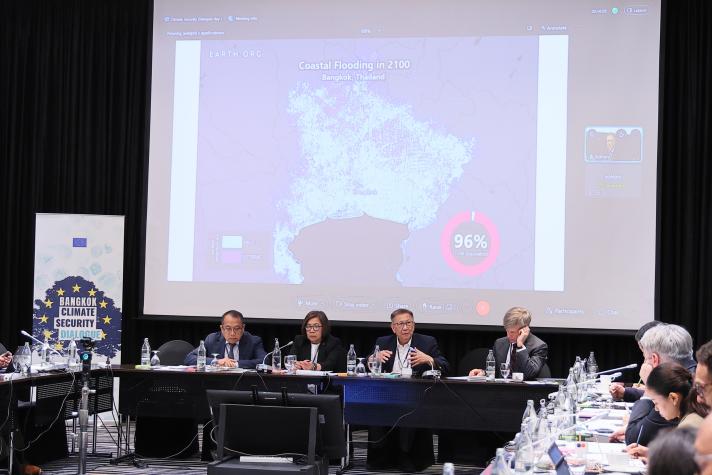
About the Climate Change and Security Regional Dialogues
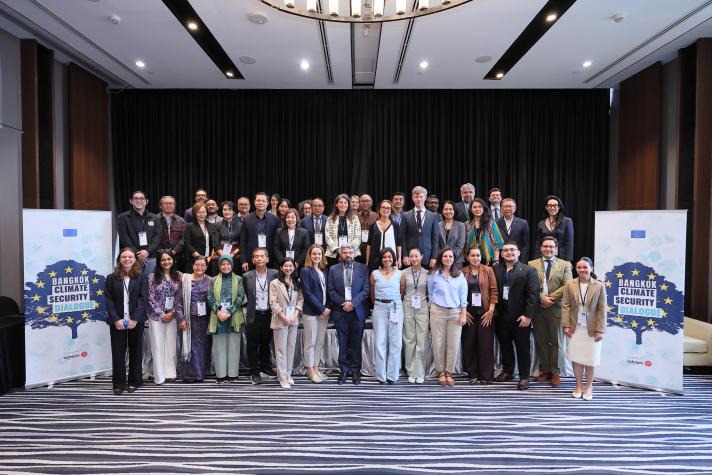
Building on the 2023 EU Joint Communication on the Climate Security Nexus, the EU has expanded its engagement on the climate, environment and security nexus in fragile contexts. In partnership with adelphi global, the EU is operationalising this commitment through a series of regional dialogues.
These dialogues aim to enhance cooperation at community, national, regional and global level, bringing together policymakers, practitioners, civil society and research institutions. By strengthening analysis, sharing experience, and fostering coordination, they seek to provide actors with the tools to manage cascading risks linked to natural resource management, environmental governance, and climate adaptation.
- Publication date
- 17 September 2026
- Threat area
- Climate change and security