

On 26 February 2026, the EU Global Threats programme project ‘Automated Arms and Ammunition Mapping 2’ released a new study focusing on the state of play in the use of artificial intelligence (AI) computer vision to enhance the detection of weapons threats in X-ray and computed tomography (CT) scanners already widely used among baggage and fast parcel post carriers. Many commercial providers of so-called Automated Prohibited Item Detection Systems (APIDS) make great claims about their ability to automate the detection of firearms and other weapon threats using AI, but independent verification of such claims has been difficult to date.
The question of how these systems are trained, and their performance and certification metrics, are growing more important in light of the increasingly complex nature of the firearm trafficking threat. Recently, for example, law enforcement and customs authorities in Europe and elsewhere report a relative increase in seized firearm parts, components and accessories compared to complete firearm systems. Many of those parts are small, harder to detect, and may be split up and hidden in separate baggage or shipments. In addition, there is a marked rise in use of different firearm fabrication techniques and materials (carbon-infused polymers, aluminium) and designs due in part to the rise of additive manufacture, including 3D printing and autoCAD. These materials not only look different, but they also exhibit densities that show up differently in X-ray scanning systems.
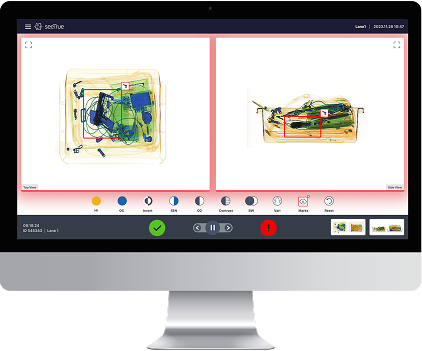
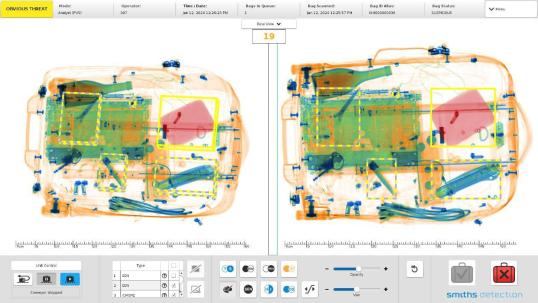
What makes an APIDS ‘automated’ are their ability to automatically recognise threat objects, or suspicious shapes. The underlying technology that empowers automated detection is called computer vision. Computer vision is a kind of AI that deploys deep learning to recognise objects by their visual signatures, edges, dimensionality and spectroscopic characteristics––that is, how materials react to electromagnetic radiation of different wavelengths.
The critical factor in AI computer vision performance is training data. Reaching high-performance requires a significant diversity of quality data (images). The higher the quality and quantity of training data, the more accurate the object detection. For objects that only appear rarely in baggage screening, like firearm parts and components, it can be challenging, time-consuming and costly to obtain or create enough quality data to train effective AI computer vision systems. For this reason, the authors of the assessment find that these systems remain ‘data constrained.’
Another critical finding and conclusion of the Policy Brief “From Data to Detection: AI-enhanced Weapons Detection in X-ray and CT System” is that, as APIDS detection algorithms and their certification systems advance, that they must keep pace with the evolving nature of the firearms trafficking threat. This probably requires continually refining algorithm testing and certification standards with operational (real-world) inputs from national and regional firearms trafficking experts.
The Policy Brief also suggest that the most impactful action multi-lateral bodies like the EU could take in this space would be to help address the scarcity of AI training data. This might involve moving beyond funding individual projects to a formal, coordinated European data initiative that builds on the groundwork already laid down by several individual projects. According to the authors, a large-scale, legally compliant, and ethically managed reference library of X-ray and other sensor data for training and testing AI would be a strategic asset for European security, fostering innovation and reducing reliance on non-EU data sources.
Download the full report
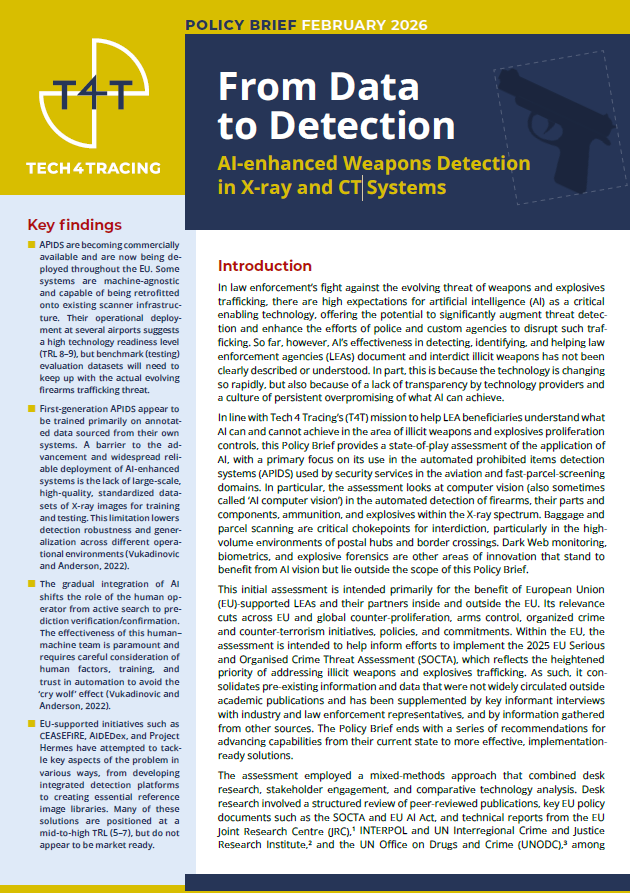
The study takes an informed look at the use of artificial intelligence (AI) to enhance the detection of weapons threats in X-ray and computed tomography (CT) systems already widely used among airline baggage security companies.
It provides an assessment of the current state of play of these systems while highlighting recent trends in firearm trafficking and sketching topics.
- Threat area
- Counter-Terrorism, Prevention of Violent Extremism
- Fight against Organised Crime
About the AAAM2 project

This project aims to make explosive ordnance (EO) detection, identification, recognition, mapping, and data collection more accurate, safer, and more effective through the application of new AI and computer vision technologies.
Implemented by Tech4Tracing, this project is active until June 2026. Phase 2 of AAAM2 is scaling up detection capabilities to cover a wider range of weapons and expand deployment through partnerships with law enforcement, counter-trafficking, and counter-terrorism actors, creating synergies with existing EU counter-proliferation initiatives.
- Publication date
- 4 March 2026
- Threat area
- Counter-Terrorism, Prevention of Violent Extremism
- Fight against Organised Crime