

Launched in July 2025, the project is implemented by Women in Technology Albania (WIT), supported by Hedayah – The International Centre of Excellence for Countering Extremism and Violent Extremism – through the EU Global Threats programme STRIVE II Global Programme, and coordinated nationally by the Center for the Coordination Against Violent Extremism (CVE Center Albania).
Since its launch, the project has reached 380 participants across Albania — of whom 71% are girls and young women — reflecting a strong commitment to gender-inclusive approaches in digital resilience and counter-extremism education.
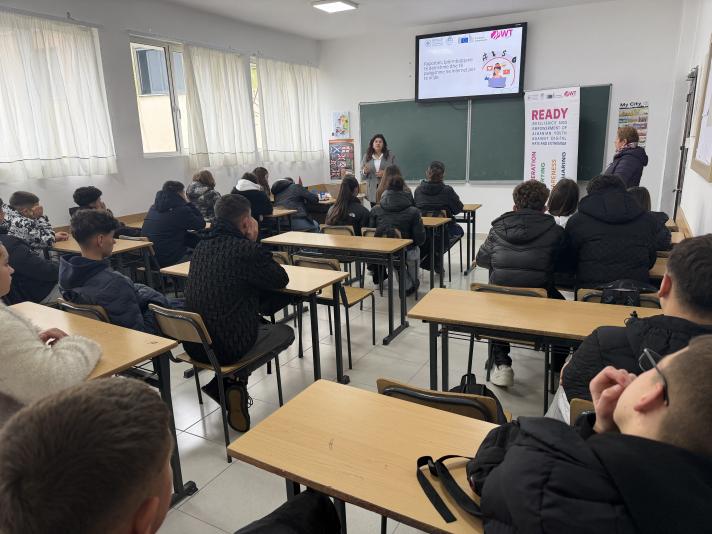
In early April 2026, WIT Albania conducted a new series of targeted capacity-building activities at "Gjergj Pekmezi" High School in Pogradec, engaging students and teachers in structured sessions on online risks, hate speech, and digital radicalisation.
Empowering students against online risks and digital extremism
The first session engaged high school students in an interactive, awareness-raising training on online safety and responsible digital citizenship. Through structured discussions and real-life examples, participants examined critical themes including exposure to harmful content, cyberbullying, hate speech, and the behavioural impact of digital environments — as well as practical strategies for identifying and reporting extremist or unsafe online material.
Students were challenged to actively reflect on their responsibilities as digital citizens and to commit to safer, more informed online practices.
Frontline educators as key actors in prevention and early identification
The second session was dedicated to teachers, school counsellors, and educational staff — recognizing their unique position as the first line of defence in identifying and responding to early signs of digital radicalisation among youth.
Participants deepened their understanding of behavioural indicators of radicalisation, the social and environmental risk factors that increase youth vulnerability, and the concrete role that educational institutions play in prevention, intervention, and timely referral. Special attention was given to existing reporting mechanisms and how educators can activate them effectively within their professional context.
Through facilitated discussions grounded in real classroom scenarios, frontline educators exchanged experiences and built practical skills to navigate sensitive cases with confidence, care, and institutional accountability. The session underscored that schools are not isolated actors — but essential nodes within a broader, coordinated network of institutions and communities committed to protecting young people from online threats and extremism.
From awareness to action: the red button as a tool for digital resilience
The activities in Pogradec placed the Red Button — Albania's national mechanism for reporting harmful online content — at the centre of training for both students and frontline educators. Participants learned to recognize, report, and respond to online threats, transforming awareness into concrete, coordinated action across the entire school community
"I never knew I could do something about the harmful content I saw online. Now I know exactly how to report it."
— Student participant, "Gjergj Pekmezi" High School, Pogradec
STRIVE HEDAYAH: Strengthening Resilience to Violent Extremism
Since 2015, the STRIVE Global Programme, funded by the European Union and implemented by Hedayah, has provided assistance to governments and civil society organisations (CSOs) to implement activities as outlined in their respective countries’ National CVE Strategies and Action Plans, and fostered cooperation between CSOs and governments.
Download the project factsheet
- Publication date
- 28 April 2026
- Threat area
- Counter-Terrorism, Prevention of Violent Extremism