

Airports are cities within cities: bustling, complex, and full of passengers and staff who come and go. Now, imagine a chemical or radiological incident unfolding in one. Who responds first? Who is in charge? And most critically, does everyone know their role?
Mongolia and the European Union (EU) are working on this.
The starting point: Identifying gaps
Since 2025, through its CBRN Risk Mitigation Centres of Excellence (CoE), the EU has been supporting discussions with Mongolian authorities which resulted in training and a field drill designed to ensure the effectiveness of the entire response chain, among other exercises.
From the classroom to the field: Putting response capacities to the test
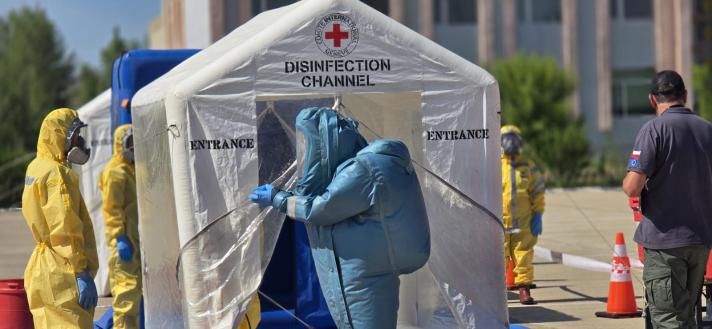
This week, in Ulaanbaatar, Mongolian first responder and decision-makers were invited to follow a training and field drill to develop operational coordination, inter-agency communication, and response procedures during complex CBRN incidents at critical infrastructure sites.
The week began with a theoretical component that covered CBRN hazard detection and sampling, casualty management and decontamination. Then, responders were put to the test. They had to respond to a drill scenario involving a chemical and radiological terrorist attack at the airport.
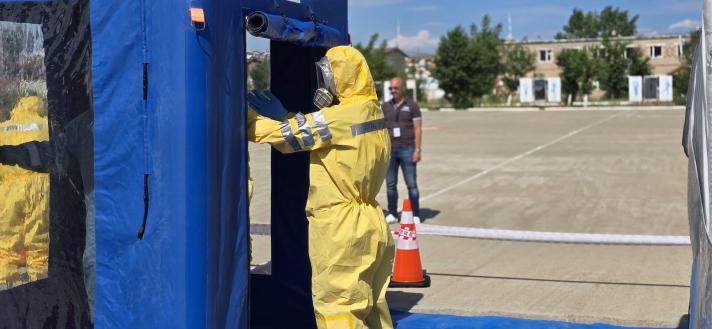
More than 50 participants from various response agencies took part in the training. They tested their procedures against a realistic scenario trained by 9 international experts operating under the EU CBRN CoE. Under the realistic conditions of the scenario, with time constraints and a multi-hazard, high pressure environment, local response teams were able to confirm the effectiveness of the current arrangements and to identify elements which could be enhanced.
Beyond the drill: A safer Mongolia, a safer world
A drill is only as valuable as the changes it inspires. For Mongolia, this week in Ulaanbaatar was never just about running a scenario. It was about building systems that could one day be vital.
Lessons identified during the training and field drill will feed directly into updated procedures, revised coordination frameworks. Eventually, response teams will be put to the test again, in a future field exercise designed to push them even further.
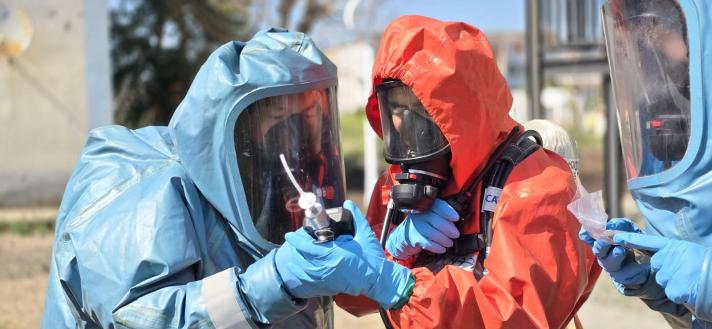
This exercise was organised under Project 106: TEST - CBRN Tabletop and Field Exercises, Simulations, Trainings to Mitigate Risks of the EU Global Threat Programme and demonstrates the EU’s commitment to building a safer world.
Through the EU CBRN CoE, this partnership between the EU and Mongolia reflects something larger than technical cooperation. It is a shared recognition that CBRN threats do not respect borders, and that building resilience in one country strengthens security across an entire region.
Because when seconds count, preparation is everything – working together saves lives.
Download Project 106 factsheet
- Publication date
- 29 June 2026 (Last updated on: 3 July 2026)
- Threat area
- CBRN Risk Mitigation
- CBRN areas
- Public and infrastructure protection
- Public health impact mitigation
- CBRN categories
- Biological
- Chemical
- Nuclear
- Radiological
- EU CBRN CoE Region
- CA - Central Asia