

A statuette wrenched from a temple. A mosaic chiselled from a wall. A manuscript smuggled out of a war zone. By the time an antiquity reaches a gallery, an auction house or a private collector, it has often passed through half a dozen jurisdictions, several shell companies and a chain of intermediaries designed to obscure its origins. What looks like a transaction in beauty is, increasingly, a transaction in laundered money.
Art and antiquities trafficking is one of the most lucrative -yet least understood- categories of transnational organised crime. It feeds on conflict, weak governance and porous borders, and it thrives on the very thing that makes the market attractive: the discretion baked into how cultural goods are bought, valued and moved.
The investigative challenge is steep. Cases sprawl across countries, agencies and disciplines. Local law enforcement may hold one piece of the puzzle, be it a customs alert, a suspicious sale or an unusual wire, but rarely the full picture, the legal toolkit or the cross-border connections needed to trace the money back to its source.
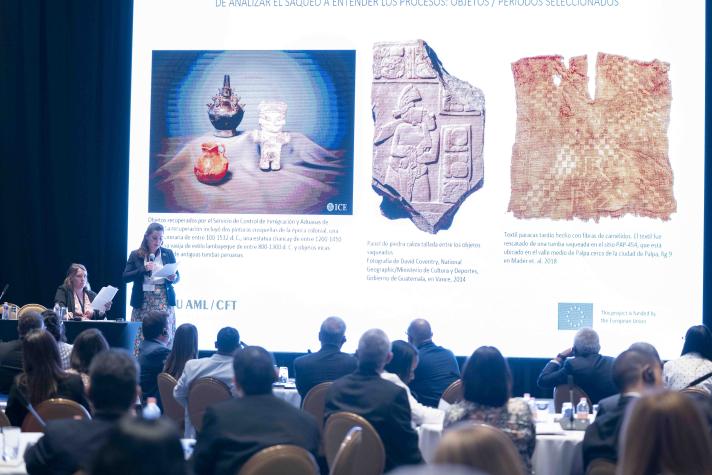
That is the gap the EU Global Facility on Anti-Money Laundering and Counter-Financing of Terrorism is working to close. Through a series of four regional conferences rolled out across the globe (Cairo in Egypt, Mexico City in Mexico, Angkor Wat in Cambodia and the fourth in planning), the EU Global Facility is bringing together Financial Intelligence Units, prosecutors, law enforcement, customs and cultural heritage experts, alongside the private sector, to share intelligence, build investigative pathways and put AML/CFT legislation to work against cultural crime.
The aim is practical: a forthcoming practitioner guidance manual, sharper cross-jurisdictional coordination, and a market made less hospitable to looted heritage. The artefact in the photo may be silent. The money trail behind it does not have to be.
About the EU Global Facility on AML/CFT
The EU Global Facility on Anti-Money Laundering and Counter-Financing of Terrorism (EU GF AML/CFT) is the European Union's flagship technical assistance instrument supporting partner countries to strengthen their AML/CFT frameworks. Funded by the European Commission's Service for Foreign Policy Instruments (FPI) and implemented by Expertise France with the GIZ, the EU Global Facility provides tailored, demand-driven support to Financial Intelligence Units, supervisory authorities, law enforcement, prosecutors and judiciaries across Latin America, the Caribbean, Africa, Asia, Eastern Europe and the MENA region.
The EU GF’s work is anchored in the Financial Action Task Force (FATF) standards and covers the full spectrum of money laundering and terrorist financing risks: from beneficial ownership transparency and virtual assets supervision to non-profit-sector regulation, corruption-related proceeds and, increasingly, the financial flows behind cultural crime.
The art and antiquities trafficking workstream sits within the Facility's broader portfolio on emerging predicate offences and contributes to the EU's wider response to transnational organised crime under the EU Global Threats programme.
Download the project factsheet
- Publication date
- 1 June 2026
- Threat area
- Fight against Organised Crime
- Events
- EU Crime Fighting Week 2026