

When a ransomware attack hits, every second counts. Evidence disappears, money moves fast, and criminals hide behind layers of encryption and blockchain complexity. Effective response to threats of this scale and complexity depends entirely on the ability of competent authorities to work together.
That is the shared understanding that shaped the 2026 Edition of the Cyber Games and Digital Security Challenge. Brought together by the Council of Europe, INTERPOL, and Morocco, 170 law enforcement and cybersecurity experts from over 50 countries were placed into mixed multinational teams and handed one mission: investigate a real-scale criminal operation, from the first alarm to the final arrest.
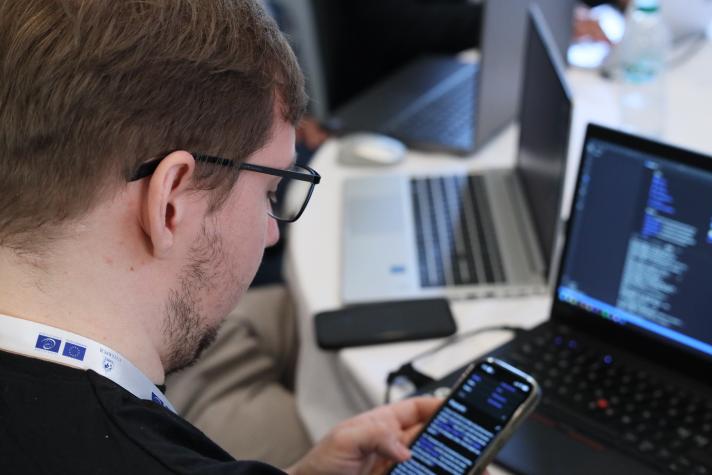
They took charge of the response, sifted through electronic evidence, traced ransom payments across multiple blockchains, hunted suspects through open sources, and ultimately delivered case files ready for prosecution. Participants worked shoulder to shoulder — different skills, different countries, one investigation. Nothing was theoretical. Every challenge mirrored a real operation. Every decision had consequences within the exercise. By the end, participants had sharpened capabilities they will carry back into real casework — stronger forensic skills, hands-on experience tracing illicit cryptocurrency flows, and direct practice with emergency cross-border cooperation tools.
In a world where cybercriminals collaborate seamlessly across borders, the defenders must do the same. The Cyber Games and Digital Security Challenge created the conditions for exactly that — building the human connections, mutual trust, and shared operational language that no training manual can teach. When the next attack comes, these professionals will not be strangers trying to coordinate. They will be a network, ready to act.
About GLACY-e
The GLACY-e (Global Action on Cybercrime Enhanced) is a joint project of the European Union (Neighbourhood, Development and International Cooperation instrument – NDICI-Global Europe) and the Council of Europe. Global Action on Cybercrime Enhanced (GLACY-e) is built on the achievements of the previous GLACY+ project and follow a similar rationale in terms of countries selected for support. The Project serves 35 countries worldwide, with eight of them acting as regional hubs and multipliers to share experience, tools, and good practices with the countries of their respective region.
Cybercrime Programme Office of the Council of Europe (C-PROC) is supporting countries worldwide in the strengthening of their criminal justice capacities to respond to the challenges posed by cybercrime and electronic evidence on the basis of the Budapest Convention on Cybercrime and its two Additional Protocols.
C-PROC became operational in 2014 and since its creation it has supported over 2700 activities benefiting some 140 countries. These activities contributed to the global standardization of cybercrime legislation, by increasing between 2013 and 2025 the number of states with substantive criminal law in line with the Convention on Cybercrime from 70 to 132.
- Publication date
- 15 June 2026
- Threat area
- Fight against Organised Crime
- Events
- EU Crime Fighting Week 2026